Here’s the disconnect most self-employed borrowers don’t discover until it’s too late:
Those two goals? They often work against each other.
Let’s break it down:
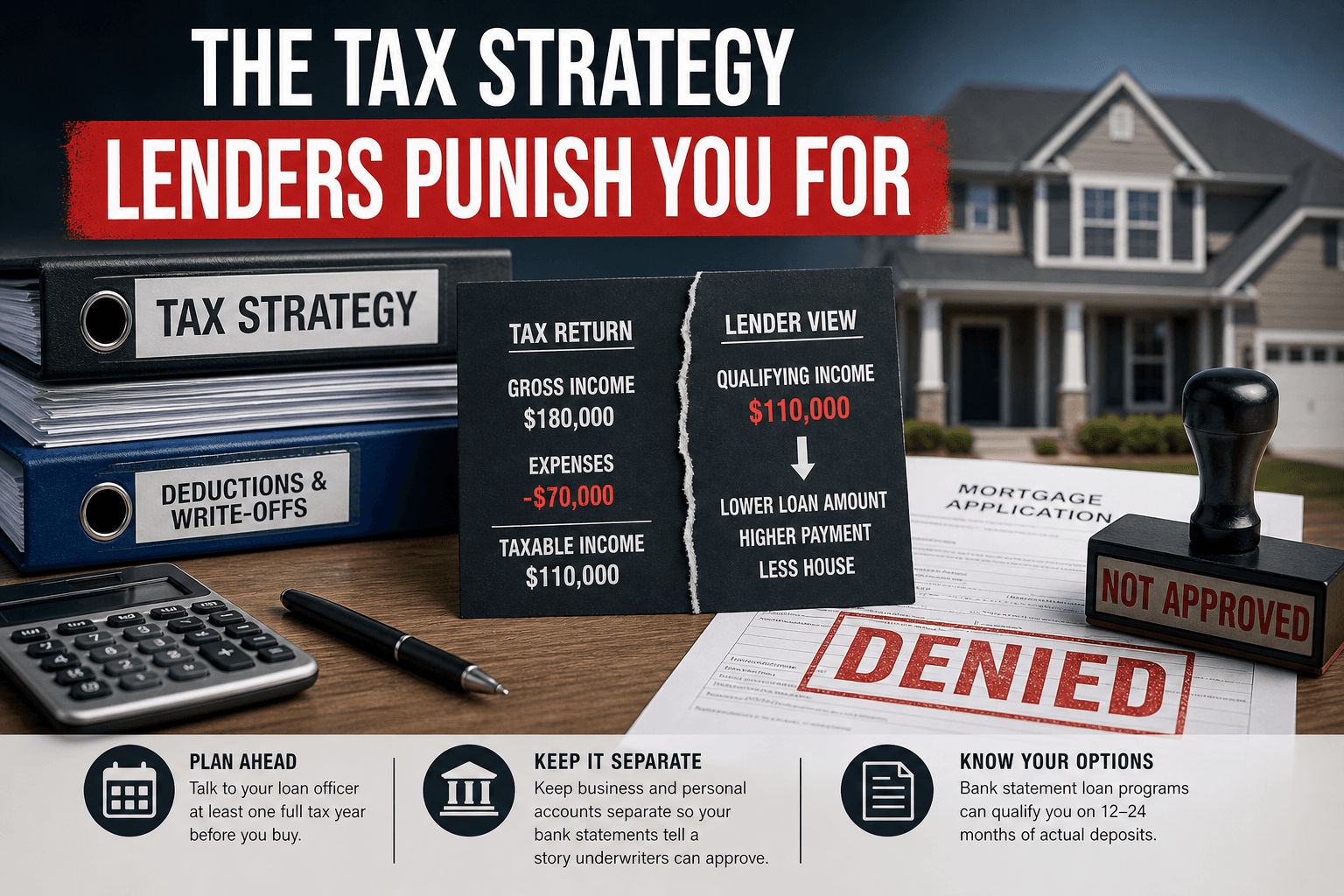
A contractor grosses $180,000/year
Writes off $70,000 in expenses
Now shows $110,000 in taxable income
From a tax standpoint, that’s efficient.
From a lending standpoint?
You don’t qualify on $180K you qualify on $110K.
That single number impacts everything:
Same business. Same cash flow. Completely different outcome.
Underwriters don’t approve loans based on what you made.
They approve loans based on what you can prove on paper.
Your tax return becomes the lens they use to evaluate your financial story.
And if that story is minimized too aggressively… your borrowing power shrinks with it.
If you’re self-employed or have complex income, timing and strategy matter more than most people realize.
Here’s what separates approved borrowers from declined ones:
Talk to your loan officer at least one full tax year before you plan to buy.
Why?
Because many deductions are discretionary or timing-based.
With proper planning, you can balance tax savings with qualifying income.
Underwriters don’t just review numbers they read patterns.
Your bank statements should tell a clean, logical story.
Traditional loans rely heavily on tax returns but they’re not your only path.
Bank Statement Loan Programs exist specifically for this situation.
Instead of focusing on your net income after write-offs, they evaluate:
For many entrepreneurs, this is the difference between a “no” and a “yes.”
The borrowers who get approved aren’t just “lucky.”
They understand something critical:
Your tax return is just the first page of your financial story not the whole book.
They plan ahead.
They align their tax strategy with their homeownership goals.
And they work with professionals who understand both sides of the equation.
If you’re self-employed, your biggest financial advantage your ability to control your taxable income can also become your biggest obstacle when it comes to qualifying for a mortgage.
The key isn’t choosing between tax savings and homeownership.
It’s strategically aligning both.
For educational purposes only. All loans subject to credit approval and underwriting guidelines. Terms and conditions apply.