Jumbo Loans With Less Than 20% Down: What Buyers Get Wrong in 2026
Most buyers walk into a jumbo purchase carrying one assumption they never questioned: that a large loan requires twenty percent down. It is one of the most persistent myths in residential lending, and in 2026 it costs qualified buyers hundreds of thousands of dollars in unnecessary liquidity every year.
The rule is not a rule. It is a habit, inherited from a different era of lending and repeated often enough that it started to sound like law.
Here is what the current guidelines actually allow.
Where jumbo territory begins in 2026
A jumbo loan is any mortgage that exceeds the conforming loan limit set each year by the Federal Housing Finance Agency. Loans at or below that limit can be sold to Fannie Mae or Freddie Mac. Loans above it cannot, which is why they are called nonconforming.
The 2026 baseline conforming loan limit is $832,750, with higher thresholds in designated high cost counties.
That number matters more in some markets than others. In San Diego, across much of Arizona, and along Colorado's Front Range, a home does not need to be extravagant to push a buyer into jumbo financing. A move up purchase in a good school district can cross the line. Many buyers arrive at jumbo territory without ever thinking of themselves as luxury buyers.
Why jumbo rules are different from what you expect
Because these loans cannot be sold to the agencies, most jumbo lending is held in portfolio. The lender keeps the loan and keeps the risk.
That single fact changes everything downstream. When an institution keeps the risk on its own balance sheet, it also writes its own guidelines. It is not bound to a rulebook written for a national average borrower. It can look at the whole picture: reserves, credit depth, career stability, business performance, and the quality of the asset.
The result is a category of lending that is frequently more flexible than conforming, not less. That surprises most buyers, because the loan amount is larger and the instinct is that larger means stricter.
What is actually available with less than 20% down
For qualified borrowers, current portfolio jumbo programs commonly allow:
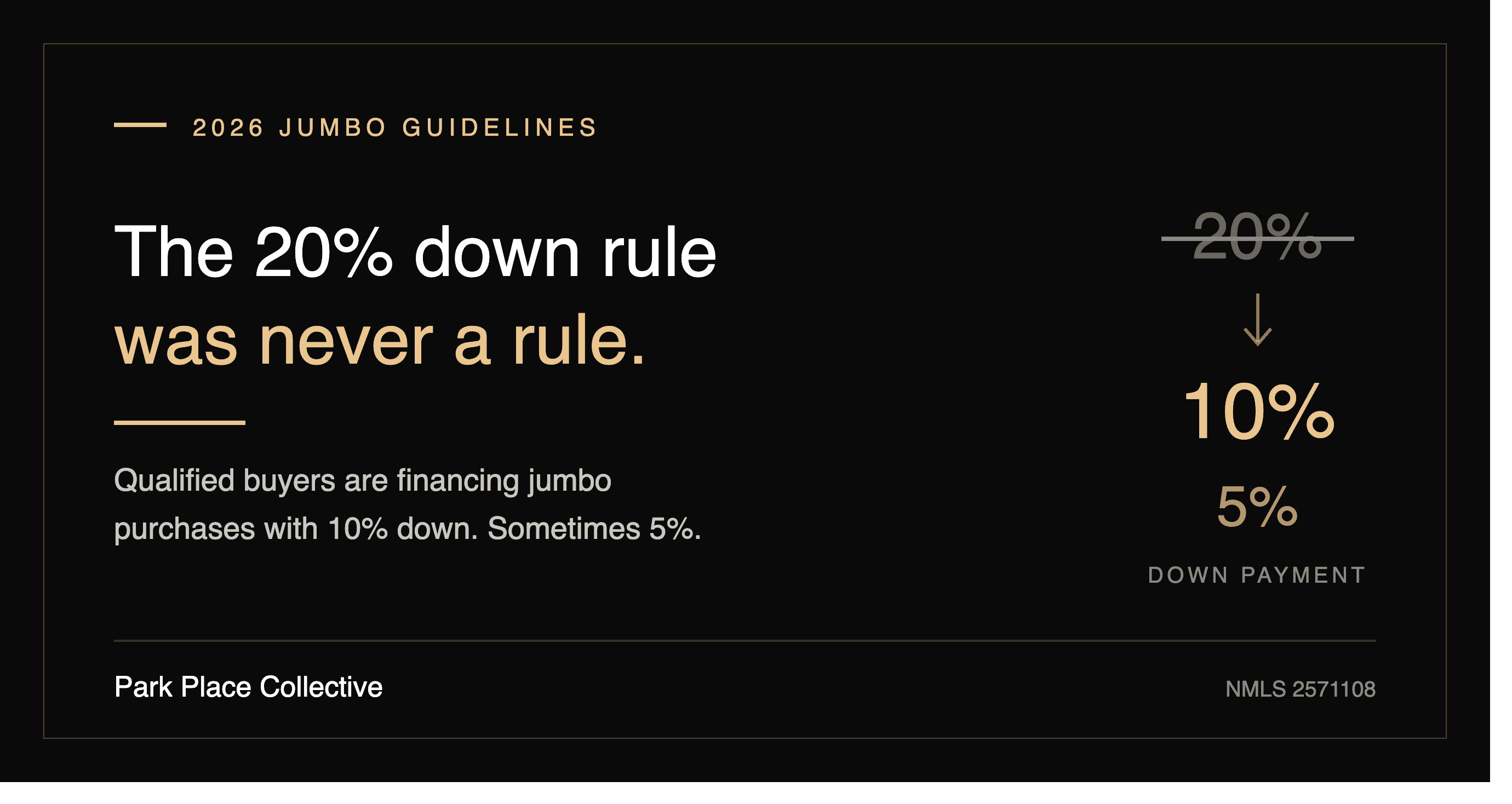
Ten percent down on a primary residence. Widely available across multiple investors for well qualified buyers with strong credit and documented reserves.
Five percent down in select scenarios. Narrower in availability and more sensitive to credit profile, loan amount, and property type, but real and in use.
Financing without separate monthly mortgage insurance. Many portfolio jumbo programs are structured to avoid a standalone mortgage insurance premium even at reduced down payments, handling the risk through pricing or loan structure instead. This is one of the biggest and least understood differences between jumbo and conforming lending at similar loan to value levels.
Vested retirement accounts counted toward reserves. Jumbo files carry meaningful reserve requirements, and reserves are frequently the quiet reason a strong borrower gets stuck. Many programs will count vested retirement assets toward those reserves after closing without requiring you to liquidate anything or trigger a distribution.
Terms and eligibility vary by borrower, property, and program. The point is not that every buyer qualifies for every structure. The point is that the twenty percent assumption eliminates options before anyone has run the numbers.
The self employed problem
For business owners, the down payment is often not the real obstacle. Qualification is.
A borrower who takes legitimate deductions to manage tax liability ends up with a return that understates true earning capacity. A conventional underwriter reads that return literally. The result is a strong borrower who looks weak on paper.
This is exactly what alternative documentation programs were built to solve.
Bank statement qualification uses twelve or twenty four months of business or personal deposits to establish income rather than relying on net figures from a tax return.
Asset based qualification, sometimes called an asset depletion or asset qualifier program, converts a documented asset base into qualifying income for borrowers whose wealth does not show up as wage income.
Income stacking combines income across multiple entities, properties, and revenue streams into a single coherent qualification picture rather than forcing everything through one narrow lens.
If a bank has told you no on a jumbo purchase, it is worth understanding whether that answer reflected your finances or simply that institution's documentation model.
The real question: what is your liquidity worth?
Set the emotion aside and treat the down payment as a capital allocation decision, because that is what it is.
On a $2 million purchase, the difference between twenty percent down and ten percent down is $200,000. Money placed into equity is illiquid. It earns no independent return, and reaching it later requires a refinance, a line of credit, or a sale, each on someone else's timeline.
Money that stays in your operating account or portfolio remains deployable. It funds inventory, covers a hiring window, absorbs a slow quarter, or captures an opportunity that shows up without warning.
None of that means smaller is always better. A larger down payment sometimes wins outright, particularly where pricing improves meaningfully at a lower loan to value, or where a buyer holds more capital than deployment ideas. Rate, payment, and total cost all move with the structure you choose.
The mistake is not choosing twenty percent. The mistake is choosing it by default, without ever seeing the alternative modeled next to it.
How we approach it
The Park Place Collective Team works through jumbo scenarios by running the structures side by side. Twenty percent down, ten percent down, and where applicable five percent down, with the payment, the pricing, the reserve requirement, and the capital left on your balance sheet in each case.
Then you decide with numbers in front of you.
Mortgage, real estate, and life insurance sit under one roof here by design, because a decision this size rarely stays inside a single category. We are licensed in California, Arizona, and Colorado.
If you are considering a purchase above the conforming limit, or you have already been told no somewhere else, a conversation before you commit the cash is worth having.
Explore our loan programs. Run the numbers with our mortgage calculators. Schedule a call. Or apply now.
Frequently asked questions
Can you really get a jumbo loan with 10% down?
Yes. Multiple portfolio programs allow ten percent down on a primary residence for well qualified borrowers. Five percent down exists in select scenarios with tighter parameters. Approval depends on credit, reserves, income documentation, and the property itself.
Do you have to pay mortgage insurance on a jumbo loan under 20% down?
Often no. Many portfolio jumbo programs are built to avoid a separate monthly mortgage insurance premium, addressing the risk through pricing or structure. This differs by investor and program.
What is the 2026 conforming loan limit?
The baseline limit for 2026 is $832,750, with higher limits in designated high cost counties. Any loan above the applicable limit is considered jumbo.
Can a self employed borrower get a jumbo loan?
Yes. Bank statement programs, asset based qualification, and income stacking are designed specifically for borrowers whose tax returns understate their earning capacity.
Are jumbo rates higher than conforming rates?
Not necessarily. Jumbo pricing is set by the institution holding the loan and moves independently of agency pricing. In some markets and at some loan to value levels jumbo pricing is competitive with or better than conforming.
Do jumbo loans require more reserves?
Generally yes. Reserve requirements are typically higher than conforming, though many programs count vested retirement assets toward those reserves without requiring liquidation.
Joe Costa, Co Founder and CEO, Park Place Collective
Licensed in California, Arizona, and Colorado
Email jcosta@parkplacefg.com | Office 619-990-7552 | Cell 646-245-7856 | NMLS 2571108 | DRE 02230476 | DFPI 60DBO-212395 | Joe Costa NMLS 113396, DRE 01410823 | Marni Costa DRE 01858497 | Ellie Taj DRE 01762442
Equal Housing Lender. All loan programs are subject to credit approval, underwriting guidelines, and program availability. Rates, terms, and eligibility vary by borrower profile, property type, and market conditions and are subject to change without notice. This content is educational only. It is not a commitment to lend, an offer of credit, or tax, legal, or investment advice.